Showing posts with label #PTC5Designforlearning. Show all posts

Monday, December 4, 2023

Just how inclusive is your science curriculum?

There are four questions I urge you to go and investigate in your school... 
  1. If I struggled to read and write, how much of the learning in your year 9 and 10 programmes would be accessible to me?
  2. How many of the scientists who are acknowledged in your school's science curriculum are women? Māori? Pasifika? BIPOC? 
  3. How many Māori and Pasifika students graduate from your school with 3 UE STEM subjects? 
  4. How many Māori and Pasifika students from your school go on to a science pathway?


    I am a science teacher. I enjoy science. But the more I learn about culturally sustaining pedagogy, students with diverse learning needs, equity, and feminism, the more frustrated I have become with science. To become a 'scientist,' you have to find a way to pay for a bachelor's degree, master's degree, and a PhD. If you are lucky you might then get a lowly paid postdoc position after that. This is hard for individuals to afford, never mind for those people with a family for which they are financially responsible. If you don't have a family that can support you financially through all these years of studying, what are the chances that you become a scientist? 

    I also think about the experience I had of science at school. All assessments required a lot of reading and writing, even at years 9 and 10. If you are a student who struggles with literacy, how accessible is our school science curriculum to you? And as a result, what impact does that have on your scientific literacy in the future? In the misinformation crisis that the world currently finds itself in, surely science teachers should be focussing on designing the most inclusive and accessible curriculum possible? (Note, I do not suggest we water down the science, only that we make it more accessible). 

    It is with the above in mind that I spent a significant amount of effort in the last few years working on how the science ideas that we teach in year 9 and 10 can be made more accessible through the way I design learning. Here are a few of the things that stand out from this year. 


    Engineering challenges

    Physics has many great opportunities for students to explore scientific concepts in a hands on way. One of the tried and tested ways to do that is by haivng students design small vehicles within a set of constraints, and then race them. As a result, I saw students investigate aerodynamics, how to reduce friction, how mass and accelleration might relate to each other, and a whole bunch more. The vehicle on the right was particularly memorable as the group experimented with using wax on the bottom of their racer to help it glide down the racing ramp easier.


    Other engineering challenges include building an arthropod that is able to move. For this, students had to learn about the characteristics and taxonomy of different arthropods, as well as learning about the physics of simple machines to help their arthropods move. The arthropod machine on the right used a wheel and axle to create their insect that moves with wind. It was particularly rewarding being able to work with a hard materials teacher who was able to help students construct and prototype their designs in the workshop. 


    Art 

    A favourite medium that I like to use when encouraging students to communicate science ideas is through art. This has involved everything from photo essays, illustrations, performances and more. However this year I was able to take my love for art and science to a new level by co-teaching with an art teacher. Students explored a socio-scientific issue of their choice from a provided list. As they explored the scientific, cultural, economic, ethical and other perspectives of their issue, they created a series of artworks to represent their understanding of these. 

    The image below shows the Alexander Calder inspired mobiles students made to represent the different persepctivees around their socio-scientific issue. 


    A critical skills in science is observation. Few things teaches observation as well as teaching drawing skills in art. Hence, another task that worked really well was having students create a nature journal page of a native species of plant. You can see the task instructions below along with an example of a student's work. 


    Prioritising tools with UDL features

    A fairly simple way of creating a more inclusive classroom is just about being more selective with the tools we use. For example, Quiziss is a en excellent tool. While it works much like Kahoot, Quizizz has the added benefit of being able to read the questions out loud to students. The tools is gamified for extra engagement and gives students instant feedback. On the teacher side of things, this tool is compatable with Google Classroom which means I can keep track of student understanding really easily. 

    I am also a serious user of Google Classroom. When used effectively, it means that students can use speech to text tools to read instructions for tasks. Hence, I religiously post every single instruction for my class on Google Classroom. It also means that it easy to make videos, audio recordings, diagrams, etc. available for students. 


    Where to next?

    In 2024 I hope to continue exploring ways to make science more inclusive, I am looking forward to working with the new level 1 NCEA standards to find ways to assess these in the most creative, inclusive way possible. 

    Wednesday, November 30, 2022

    Google Classroom grade book

    Today's post is a screenshot from one of my Google Classroom's grade books (student names removed). This year I have really focused on using this function to help students track their progress in my courses more effectively. There are a number of ways I have done this:
    • Using the grade book effectively makes it easier to see if a student is not turning in work on a consistent basis. Eg. at a glance you can see that student 5 has some major concerns below. 

    • Any tasks that I use to make my overall judgment for their grade at the end of the term are signposted. This way students know which tasks to invest extra effort in, rather than just getting them done.  (I have found that it is important to teach students when to focus on 'good enough' and when to focus on 'perfect'). 

    • By using a consistent grade allocation for tasks related to their report, I can use the overall grade function to track the 'level' they are working at more consistently and with less bias. 

    • During class time students are regularly asked to look at their overall grade, and then take action to improve them. This looks like students finishing incomplete tasks, catching up with work from when they were absent, and most frequently, going back to past work and improving the quality of work that they produced. 
    The major benefits of using this system this year have meant that reports have been SUPER FAST to complete. Students are much clearer about where their report grades come from and have devoted significantly more energy to 'improve'. 
     

     ("It's been a little while since I've blogged regularly so to get back in the habit, I thought I would share one photo every day for the remainder of the school year to capture some of my learning, reflections, and creations for 2022. Each photo is accompanied by a short caption. The idea is to keep it short, simple, and reflective. I would love for people to join me - if you do, make sure you include #edphoto22 on whatever platform you share it (Twitter, Mastodon, Facebook, Instagram, wherever...)."

    Thursday, November 24, 2022

    Whakatauki cards

    I am always looking for ways to bring more te reo Māori into my classes. However, doing this in a really meaningful way when my own understanding of the reo is limited can be a challenge. One resource that I created this year to help are the cards pictured in these photos. I collected a range of whakatauki from this book with their translations and a brief explanation of their meaning. I then created a number of activities to use with students. This worked even better than I expected as students really enjoyed the discussions of how these important generational lessons applied to them. 


    ("It's been a little while since I've blogged regularly so to get back in the habit, I thought I would share one photo every day for the remainder of the school year to capture some of my learning, reflections, and creations for 2022. Each photo is accompanied by a short caption. The idea is to keep it short, simple, and reflective. I would love for people to join me - if you do, make sure you include #edphoto22 on whatever platform you share it (Twitter, Mastodon, Facebook, Instagram, wherever...)." 

    Wednesday, November 23, 2022

    Growth mindset ludo


    A resource I have been working on this year is 'growth mindset ludo'. As students move around the board, they land on various reflection questions about fixed and growth mindsets to help them identify the patterns in their own thinking. After all, it is reflection that helps us learn from our mistakes and improve. I'll make sure to share more about this game when it is done. 

    ("It's been a little while since I've blogged regularly so to get back in the habit, I thought I would share one photo every day for the remainder of the school year to capture some of my learning, reflections, and creations for 2022. Each photo is accompanied by a short caption. The idea is to keep it short, simple, and reflective. I would love for people to join me - if you do, make sure you include #edphoto22 on whatever platform you share it (Twitter, Mastodon, Facebook, Instagram, wherever...)." 


    Friday, November 18, 2022

    Bones


    The misinformation around COVID and vaccination has particularly highlighted for me the importance of ensuring that science needs to be more inclusive. This year I've been trying to assess science in more ways than just writing. One of the ways that I believe science excludes students is that it relies too heavily on writing to communicate an understanding of scientific ideas. Hence, this year I designed and taught a unit called Bones. We focused on creating models and representations of bones. This illustration was produced by a year 10 student. Pretty amazing right? 


    ("It's been a little while since I've blogged regularly so to get back in the habit, I thought I would share one photo every day for the remainder of the school year to capture some of my learning, reflections, and creations for 2022. Each photo is accompanied by a short caption. The idea is to keep it short, simple, and reflective. I would love for people to join me - if you do, make sure you include #edphoto22 on whatever platform you share it (Twitter, Mastodon, Facebook, Instagram, wherever...)." 

    Thursday, November 17, 2022

    Elwyn Richardson


    The pottery work in this photo is some of the artworks produced by the students of Elwyn Richardson. If you don't know, Elwyn was an influential educator both in New Zealand and internationally for the impact his educational philosophy had. I was lucky enough to get to see some of these artifacts in person earlier this year when I visited the University of Auckland's Epsom Campus. I include this photo here because it is a good reminder that sometimes we have to break the rules to succeed. It is when we break the rules that we are able to break free from racist institutions. It is when we break the rules that we see innovation occurring. However, knowing when to break the rules and when not to requires wisdom. So just how does one acquire wisdom?


    ("It's been a little while since I've blogged regularly so to get back in the habit, I thought I would share one photo every day for the remainder of the school year to capture some of my learning, reflections, and creations for 2022. Each photo is accompanied by a short caption. The idea is to keep it short, simple, and reflective. I would love for people to join me - if you do, make sure you include #edphoto22 on whatever platform you share it (Twitter, Mastodon, Facebook, Instagram, wherever...)." 

    Friday, November 11, 2022

    Photo essays


    One of the things that frustrate me about our current education system is that it has a bias toward using writing as a means to represent learning. Students are asked to write essays, write reports, write an email, write a letter, write a story. In science, this is particularly evident through the prioritisation of exams, tests, and reports that remain fixed as one of the primary means to assess students (not in all contexts but in many). I have a hunch that this bias contributes to the lack of cultural and gender diversity represented in science fields. In response, I wanted to spend some time this year emphasising some other modes of communicating ideas in science. The photo above was taken by a student as part of their photo essay about climate change. Here is the task I used to scaffold students in their photo essays. 

    ("It's been a little while since I've blogged regularly so to get back in the habit, I thought I would share one photo every day for the remainder of the school year to capture some of my learning, reflections, and creations for 2022. Each photo is accompanied by a short caption. The idea is to keep it short, simple, and reflective. I would love for people to join me - if you do, make sure you include #edphoto22 on whatever platform you share it (Twitter, Mastodon, Facebook, Instagram, wherever...)."

    Tuesday, November 8, 2022

    Inquiry baskets of knowledge

    It's been a little while since I've blogged regularly so to get back in the habit, I thought I would share one photo every day for the remainder of the school year to capture some of my learning, reflections, and creations for 2022. Each photo is accompanied by a short caption. The idea is to keep it short, simple, and reflective. I would love for people to join me - if you do, make sure you include #edphoto22 on whatever platform you share it (Twitter, Mastodon, Facebook, Instagram, wherever...). 


    This is a photo of students' literal baskets of knowledge. Their key learning and questions from their inquiries were summarised on strips of paper that were then weaved into a kete (basket). Students also reflected on the purākau (story) of Tāne and the baskets of knowledge and what this could teach them about how to tackle their own pursuit of knowledge in their inquiry. Here is the full resource if you wish to repurpose or reuse it.

    Tuesday, December 14, 2021

    Reflecting on the practicing teacher criteria 2021

    To have spent so many months working from home in a job that usually involves so much face to face time, has made 2021 feel like a bit of an odd year for msot Auckland based teachers. So many of my usual patterns and routines as a teacher was disturbed, and so many plans were disrupted. And while supporting student learning from home is certainly not the norm, it doesn't change the professional responsibilities we hold. In fact, as I reflected on the practicing teacher criteria for 2021, I was reminded once again of just how flexible we need to be if we are to support our learners effectively in such uncertain, and somewhat volatile times. 


    What follows is a brief reflection about how I attempted to address the practising teacher criteria in 2021. I have included some examples of my practice, as well as a brief reflection on some of my next steps for 2022. 

    Tuesday, September 7, 2021

    Ghostbusters! - Dealing with ghosting students in lockdown (and the classroom).

    We are back in lockdown thanks to COVID and the delta variant. As the days pass while teaching remotely, it becomes increasingly apparent that some students struggle to engage in lockdown more than others. And some of them try their best to ghost you. As always, it is often these disengaged students that are the most vulnerable and at risk. So how do we get them engaged again? 

    What became overwhelmingly clear as I sifted through the research, teacher, and student feedback is that good practice is good practice - regardless of whether you are teaching in person or remotely. All of the recommended practices, strategies, tools, etc. reflect the key messages from the OECD's The Nature of Learning report. (If you haven't read this yet, do so urgently. It provides a really great summary of research to inspire good teaching practice.)

    Of particular relevance are the 8 basics of student motivation that this report summarises:


    This post is a list of ideas, recommendations, and best practices compiled from teacher feedback on Twitter, reports from ERO (New Zealand Education Review Office), the Education Hub, as well as a student survey done at Hobsonville Point Secondary School. 

    How do you know if you have a ghost?
    The Responding to the Covid-19 crisis: Supporting Auckland NCEA students report clearly identifies that the longer a student is disengaged, the harder it is to reengage them. Hence, it is important to reach out to disengaged students as early as possible. Additionally, focussing on the relationship first appears to be a key aspect of getting our ghosts engaged, and keeping them engaged
    • Setting up tasks that 'self mark' so that it is easy to track disengagement with minimal effort eg. Google Quiz through Google Classroom, Quizizz, Playposit, Education Perfect, Pear Deck. 
    • Using the assignment function through Google Classroom to make it easy to see when students have turned in work or turned work in late. 
    • Using the grade book function in learning management systems (eg. Google Classroom) to track overall engagement. 
    • Doing a roll in synchronous video calls. 

    How do you stop them from being ghosts in the first place?
    As with so many other things in education, relationships are at the heart of the matter. Hence, we need to think about how we might maintain our focus on relationships, with students and between students. This is also great for helping students to manage their well-being in lockdown as the absence of their peers can have a detrimental effect on their mental health.  Some ways to do this include:
    • Smaller group asynchronous video calls rather than large group calls.
    • Personal emails to check in with students. 
    • Collaborative tasks that require students to reach out to their peers. 
    • Pastoral group meetups for fun. eg. quiz, pictionary, etc. 
    • Private comments through Google Classroom as reminders.
    • Email telling them I am thinking about them and miss them in class will often do the trick, especially with higher year levels. 
    • Email whanau. Call whanau if still nothing. 
    • Organising a one on one video call to check in and help problem solve any issues acting as obstacles in proceeding with learning. 
    • Organising small group synchronous video calls specifically for students who are struggling. 
    • Connecting students who need extra support with a counsellor, teacher aide to help as appropriate.
    • Support students with building self-regulating skills. Eg. helping them to fill in a daily planner, teaching them productivity tools eg. single-tasking, quick writes, kanban, etc. 
    • Don't give up. Keep emailing and calling, keep getting in touch to check how the student is doing. 

    How do you set ghost busting tasks?
    During a lockdown, it is much easier for students to opt-out of tasks that are boring, busy work, too hard, etc. Hence, the quality of the work tends to have a much bigger impact on student engagement than when we are in their faces at school actively nagging them. The research and student voice is really clear about the kinds of tasks that help to keep students engaged and as a result, motivated. As a result, we should focus on designing tasks that are:
    • Set tasks that are clearly linked and matched to the intended learning outcomes that students know and value - aka. moving beyond low-level tasks and “busy work” to tasks that students feel are important and meaningful. 
    • Scaffold. Scaffold. Scaffold. Students don't have access to the teacher or peers in the same way as at school so making sure that the tasks is broken down in a way that is easy for them to make sense of is key. 
    • Shorter instructions, which broke tasks into chunks, tended to be more effective in scaffolding students through the learning.
    • Ramping up the difficulty level in tasks as you go along to ensure that all students feel a measure of success when completing tasks. (SOLO works really well for this - see example)
    • Using Universal Design for Learning practices eg. 
      • Supplementing written instructions for tasks with short video explanations.
      • Offering personal 60 second video lessons for question messaged in the private chats.
      • Mixing up the type of tasks eg. hands-on.
    • Reduce the fear of failure such as by using gamification eg. Kahoot.
    • Providing students with a degree of choice over how they completed a task typically led to greater engagement in the learning and a higher probability of the task being completed. 

    How do you help the students manage themselves in order to avoid ghosting?
    Despite 'managing self' being one of the key competencies of our New Zealand curriculum, lockdown really highlights our short fall in helping students develop self-regulation skills. There are a number of ways that we can help students improve their self-management, and as a result, improve their engagement and motivation during lockdown and at school. Additionally, maintaining high expectations and holding students accountable for meeting these expectations is also critical for maintaining students’ motivation and engagement and facilitating learning. 

    • Ensuring flexibility in when students can do work. Too many set times reduces engagement and opportunities for self-management. 
    • Setting realistic amounts of work. Don't fall into the planning fallacy (a prediction phenomenon, all too familiar to many, wherein people underestimate the time it will take to complete a future task, despite knowledge that previous tasks have generally taken longer than planned.)
    • Set work at the start of the week so that students can plan out how they will do their learning for the week. 
    • Setting tasks that are truly independent as parents and caregivers are not always able to support.
    • Don't overload students with too much information or communication - keep it simple and concise with a clear and easy option for following up if they have questions.
    • Make videos for students to watch in their own time. 
    • Must do/Should do/Could do tasks to ensure that workload can match student context, but also to provide a sense of agency. 
    • Setting deadlines and time limits of tasks, and following up with students who have not met these. 
    • Supporting students to complete a daily planner to help them identify deadlines and prioritise their efforts (see student example from Hobsonville Point Secondary). 
    • Providing regular formative assessment and feedback that was connected to the expectations set by the teacher was crucial for motivation and engagement as well as for ongoing learning.
    • Students who established some form of routine or daily structure were more likely to stay up-to-date with work and to maintain their engagement. eg. daily small group check-in, daily planner. 
    • Use coaching conversations (eg GROW coaching) to help students problem solve and self determine their next steps. 

    Hopefully, there are some helpful ideas in here to help with your ghosts. If you have more ideas of things that have worked for you. Please leave them in the comments too!

    Further reading

    Saturday, March 28, 2020

    Power and art

    Just three months ago I was hopping across Europe visiting museums and art galleries. It seems unthinkable that so much has changed as a result of covid-19 in such a short space of time. We are now on day three of lockdown in New Zealand. And all of a sudden, I find that I have time to finish a blog post I started in January!

    This past holiday I had the pleasure of visiting numerous art galleries, listening to art history podcasts and completing Adobe Illustrator tutorials online. I also had a solid week of super intense practice while I prepared for a group aerial circus performance (that's me on the right!). While I am a science and sometimes maths teacher, I often find that the arts is where much of my inspiration comes from.


    I have learned that taking the time to be creative and appreciate the creative arts, makes a huge positive difference to my personal wellbeing. It is also more often than not, a catalyst for deep thinking and reflection in my day to day practice within education. Recently for example, I learned about artist Lisa Brice from listening to a great podcast by art curator Katy Hessel. 

    Source: Women in Art - Tate via Khan Academy

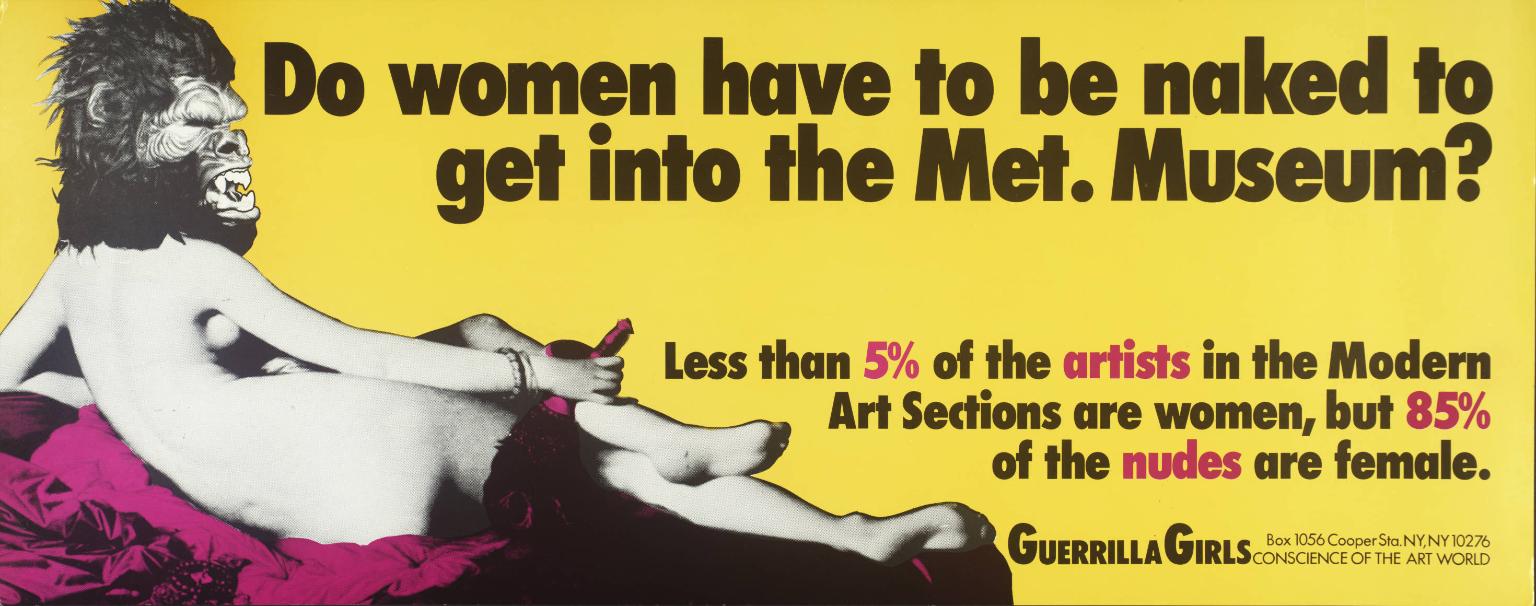
    As some of you may know, female artists are remarkably absent in art history (go ahead, make a list of all the artists you know about and then see how many are women). Women are primarily present as the subject of paintings, and hence, are always represented through a male filter, or 'male gaze' as Hessel calls it. Lisa Brice, the artist mentioned above, recasts women from art history. This 'recasting' means that historic portraits of women where they are portrayed as weak, vulnerable, where they are in positions of disempowerment and hopelessness, are reinvented to give the women power. 

    Take for example the famous "Parting at Morning" by Sir William Rothenstein (see below left). The women featured in the portrait was described in his journal as destitute. She attempted to sell him paintings. He could not afford them however instead, she posed for him to complete various drawings. He describes the women as "not without a certain cadaverous beauty" and included with her portrait a poem modified from Robert Browning:
    Round the cliff on a sudden came the sea,
    And the sun looked over the Mountain's rim:
    And straight was a path of gold for him,
    And the need of a world of men for me.
    In essence, this painting casts this woman in a 'walk of shame'. The painting and the inclusion of the poem immortalised this woman in her state of destitution and shame. What's more, there is a more convoluted message about objectification captured here, about how this woman is still pretty even if she looks like death warmed up.

    Photo on the left from Tate, and photo on the right included here without permission from Ennigaldi

    On the right, however, Lisa Brice has recast this woman. Instead of the vulnerable, destitute, cadaverous women who Browinging implies is reliant on the men in her world, she is recast to have a certain "I don't give a f*%$# and don't mess with me look about her. Brice essentially attempts to restore some power to this woman.

    So why does this matter in education? Well, the redistribution of power in these two artworks paint a stark contrast of how the same person can be represented. If we could hold up Lisa Brice's lense to education, would such a contrast be revealed there too? For example, almost every New Zealander would recognise Marcus King's famous representation of the signing of the Treaty of Waitangi (below). How might this painting be different if Māori were recast to have more power. Would there by more Māori standing rather than sitting on the ground? What else might be different? 

    Image form Archives New Zealand

    There are those who would argue that yes, women, indigenous peoples, and other minority groups are represented in ways that diminish their power within education and academic contexts (Ann Milne re. Māori, and  Jane Gilbert re. women in science, being just two names that jump to mind). With this recasting in mind, I am wondering what education might look like if power distribution was fairer. Which aspects of my classroom practice and leadership would look completely different? What knowledge and skills would be prioritised in schools instead? And most important, what can we do to ensure that our own biases don't cloud our view when we consider power distribution in education? 

    Wednesday, November 27, 2019

    Using science capabilities for assessment

    Recently, a teacher in a Facebook group asked how others set targets and measure progress in the junior science curriculum? I mentioned that at Hobsonville Point Secondary we have developed curriculum level rubrics around the science capabilities. Over the next few days, I was swamped with emails from various teachers at various schools wanting to see what we do. So I have put together a little summary for anyone interested.

    First things first... Every term, the whole school designs their junior courses around one of eight whole school concepts. These eight concepts were pulled out from an analysis of the New Zealand Curriculum. Since our year nine and ten courses are combined, these whole school concepts go through a two-year cycle.

    Each term, we have matched the whole school concept with a science capability based on the literature in TKI and the work of Ally Bull and Rose Hipkins. Every science course bases their learning and assessment around the selected science capability for the term. From here, we then developed learning objectives to further unpack the science capabilities. Each learning objective has a corresponding rubric which is used for tracking and reporting.

    Our science capability informed learning objectives
    Gather and Interpret data
    • To explore by investigating to provide evidence for [key concept] in [context].
    • To make sense by analysing and interpreting data to provide evidence for [key concept] in [context].
    Using evidence to make meaning
    • To make sense by analysing scientific evidence for [key concept] in [context].
    • To generate by constructing scientific explanations for [key concept] in [context].
    • To evaluate by critiquing scientific explanations for [key concepts] in [context].
    Interpret models and representations
    • To generate by constructing a representation or model for [key concept] in [context].
    • To evaluate by critiquing representations or models for [key concepts] in [context].
    Combination of skills to support science, technology and society
    • To generate by responding to a socio-scientific issue.
     Finally, we decide on the context of the course. For example, we might decide to focus on astrobiology. Students might learn about current theories about aliens and their locations, and then critique representations of aliens based on their new knowledge. Or, students might learn to design investigations to better understand the organisms in their local environment. We might have a civil engineering context where students might analyse and interpret data about the properties of materials. They might then use these to make recommendations for building a bridge. My personal favourite learning objective is "to generate by responding to a socio-scientific issue." We have redeveloped this learning objective for project-based learning, ensuring that at least once a year, students will immerse themself in a socio-scientific issue, synthesise key science ideas about their chosen issue, and then take appropriate action. 

    The video below was made by a group of students that were learning to model and represent forces in a circus context. (Thanks to The Dust Palace in Auckland for teaching us to use the equipment!).


    Finally, students are assessed against the rubrics we developed to unpack each of the capability-based learning objectives. The rubric below is for "to generate by constructing a representation or model for [key concept] in [context]." Assessment might involve students submitting portfolios, student interviews, videos, etc. The sky is the limit!


    CL 4
    4 Developing4 Proficient 4 Adaptive
    Construct a range of simple representations and models to make meaning. Scientific ideas are communicated by beginning to use a range of scientific symbols, conventions, and vocabulary.
    Use scientific vocabulary and conventions

    Constructs simple models or representations that make meaning by describing data or scientific ideas

    I am able to:
    Construct a simple model or representation that describes scientific information

    Make meaning by connecting scientific ideas or data to a simple model or representation
    Consistently use scientific vocabulary and conventions in a range of contexts.

    Constructs simple models or representations that make meaning by explaining data or scientific ideas

    I am able to:
    Construct a simple model or representation that explains scientific information

    Make meaning by relating scientific ideas or data to simple models or representations in a range of contexts.
    Consistently use accepted scientific vocabulary and conventions in a range of contexts

    Constructs simple models or representations that make meaning by discussing data or scientific ideas

    I am able to:
    Construct a simple model or representation that discusses scientific information

    Make meaning by considering the application of scientific ideas or data to simple models or representations in a range of contexts.
    Clarifications/Explanatory Notes/Links:
    A model or representation may be physical (e.g., diagrams, flow charts, maps, scale models), mathematical (e.g., equations, graphs) or conceptual (e.g., imagery, metaphor, analogy), and it can be specific to a discipline. There are symbols, notations and terminology that are appropriate for specific types of representations within a discipline.
    Accepted scientific vocabulary and conventions appropriate to level 4 of the curriculum.

    CL 5
    5 Developing5 Proficient5 Adaptive
    Construct a range of representations or models to make meaning. Scientific ideas are communicated using a wider range of science vocabulary, symbols, and conventions (including visual and numerical literacy).
    Use scientific vocabulary and conventions

    Constructs visual and numerical representations or models that describe by:
    communicating scientific concepts/ideas
    AND/OR
    showing patterns in data.


    I am able to:
    Construct a visual or numerical model or representation that describes scientific information

    Make meaning by connecting scientific ideas or data to a visual or numerical model or representation
    Consistently use scientific vocabulary and conventions in a range of contexts.

    Constructs visual and numerical representations or models that explain by:
    communicating scientific concepts/ideas
    AND/OR
    showing patterns in data.

    I am able to:
    Construct a visual or numerical model or representation that explains scientific information

    Make meaning by relating scientific ideas or data to visual or numerical models or representations in a range of contexts.
    Consistently use accepted scientific vocabulary and conventions in a range of contexts

    Constructs visual and numerical representations or models that discuss by:
    communicating scientific concepts/ideas
    AND/OR
    showing patterns in data.

    I am able to:
    Construct a visual or numerical model or representation that discusses scientific information

    Make meaning by considering the application of scientific ideas or data to visual or numerical models or representations in a range of contexts.
    Clarifications/Explanatory Notes:
    A model or representation may be physical (e.g., diagrams, flow charts, maps, scale models), mathematical (e.g., equations, graphs) or conceptual (e.g., imagery, metaphor, analogy), and it can be specific to a discipline. There are symbols, notations and terminology that are appropriate for specific types of representations within a discipline.
    Accepted scientific vocabulary and conventions appropriate to level 5 of the curriculum

    CL 6
    6 Developing6 Proficient6 Adaptive
    Construct a range of representations or models to make meaning by beginning to connect scientific theories, models and investigations. Scientific ideas are communicated by beginning to use accepted science knowledge, vocabulary, symbols, and conventions (including visual and numerical literacy).
    Use scientific vocabulary and conventions.

    Connect simple scientific theories, models and investigations by describing visual and numerical representations or models when:
    communicating scientific concepts/ideas
    AND/OR
    showing patterns in data.


    I am able to:
    Construct a visual or numerical model or representation that describes scientific information, by using supporting evidence.

    Make meaning by connecting scientific ideas or data to simple scientific theories, models or investigations
    Consistently use scientific vocabulary and conventions in a range of contexts.

    Connect simple scientific theories, models and investigations by explaining visual and numerical representations or models when:
    communicating scientific concepts/ideas
    AND/OR
    showing patterns in data.

    I am able to:
    Construct a visual or numerical model or representation that explains scientific information, by using supporting evidence.

    Make meaning by relating scientific ideas or data to simple scientific theories, models or investigations in a range of contexts.
    Consistently use accepted scientific vocabulary and conventions in a range of contexts

    Connect simple scientific theories, models and investigations by discussing visual and numerical representations or models when:
    communicating scientific concepts/ideas
    AND/OR
    showing patterns in data.

    I am able to:
    Construct a visual or numerical model or representation that discusses scientific information, by using supporting evidence.

    Make meaning by considering the application of simple scientific theories, models or investigations in a range of contexts.

    Choose appropriate and conventional visual or numerical model(s) or representation(s) to support an explanation of a concept, and discuss limitations of chosen models or representations
    Clarifications/Explanatory Notes:
    A model or representation may be physical (e.g., diagrams, flow charts, maps, scale models), mathematical (e.g., equations, graphs) or conceptual (e.g., imagery, metaphor, analogy), and it can be specific to a discipline. There are symbols, notations and terminology that are appropriate for specific types of representations within a discipline.
    Accepted scientific vocabulary and conventions appropriate to level 6 of the curriculum

    A few key things to note
    • These rubrics, learning objectives, etc. are not perfect. We are constantly adjusting and refining them to ensure that students gain the necessary skills and knowledge to be informed citizens and capable of success in senior science. Given the pace at which science is advancing, however, I would argue that evolving assessment and learning is the way to go...
    • You will notice that our focus in science is not on students learning about. Instead, there is a much greater focus on students learning to. This is in part as a result of the science capabilities that make some attempt at reconciling the perceived gap between skills and knowledge in the curriculum. 
    • The work of developing learning objectives and progressions is just as important, if not more so, than having a completed rubric. This is a difficult, sticky and usually confronting process. However, this process is a fundamental building block of shifting assessment away from historical modes of end of topic tests. It requires us learning to use the curriculum rather than achievement standards to dictate what and how we teach our students. It requires us to really ask 'what is science?', if it is not a unit on atoms and another on electricity. 
    • Many secondary school teachers know that there is never enough time and that we are in a constant race to 'cover all the content'. The only way of getting out of this content rat race is to let things go. If you just try to fit in more 'stuff', you end up doing more things, but worse. Instead, we are trying to do less, better. We have chosen the science capabilities because we believe they offer both access to the niche-specific knowledge of senior science, as well as providing life worthy, relevant learning for all students living in our modern world of exponential technology. Many science teachers might be alarmed that our school does not provide the stock standard introduction to the periodic table unit, and not all students will have learnt about parallel and series circuits. However, all our students will have had to explore and analyse a socio-scientific issue, and designed and prototyped an action accordingly. All students will have to use scientific evidence in some way, and be able to distinguish between what makes something scientific or not. 
    • The students in our class come from culturally and socially diverse backgrounds. They learn new skills from MOOCs and YouTube, and communicate using augmented reality (think IG filters!). The science capabilities offer enough flexibility that we can design courses around student interest while maintaining the integrity of science as a discipline.
    • We have been using this system/process for about four years now. In 2020, our plan is to extend our rubrics to include senior science courses. 
    Any questions? Comment below! 

    PS: If you are planning on redoing your science progressions, I highly recommend first reading the following:

    Monday, October 14, 2019

    Rediscovering student agency

    I realised with a shock yesterday how little I've blogged this year! So, I have set a personal challenge for myself, 10 posts in 10 days. It shouldn't be too hard to turn all of my draft posts into complete ones, right? Or post a quick vlog reflecting of my day? Or share a strategy that I have tried? Maybe you're keen to try too?

    It seems that not too long ago, everyone was talking about student agency. Many a tweet talked about self managing students, blog posts were written, and there were probably multiple sessions about it at ULean. I know Claire Amos did a great talk about it, and Steve Mouldey did a great presentation. Lately, however, I have found myself looking at these resources in a new light. I have always believed that student agency is a key ingredient for success as it helps students to become self-managing, life-long learners. I still think this a worthy goal for success in a rapidly changing, fast-paced world. However, student agency has taken on a new sense of urgency and importance in my practice of late. Prompted by my Spiral of Inquiry in 2018, I wondered whether student agency might contribute in restoring some of the power to those students and families for whom colonisation and embedded system bias has led to feeling disempowerment?

    In schools, command and control models dominate in so many ways. We tell our students where to be, when to be there, and how to act when they get there. We tell our students what to wear, what not to wear, and in some cases, what their hair can and cannot look like. We tell them when they can eat, when they may use the restroom. We tell our students what they should learn, and how they should learn it. Whether inadvertently or not, we decide what our students should value through deciding how they should spend their time, what we assess, and what qualifies as "justified" reasons for missing school. The trouble is, every decision that we make FOR students rather than WITH students is another instance where we are removing agency and power.

    Once I began to notice all the ways that I remove agency from my students, I was alarmed to discover that in my own practice, despite priding myself on a student-centred philosophy’ I was constantly enacting my power over the students. I began feeling uncomfortable that 17 and 18-year-old students felt the need to ask permission to go to the toilet. If we cannot even trust young people with going to the toilet, then what kind of messages were we sending about trusting them with their learning? And while we might argue that some students misbehave and cannot be trusted to go and come back in a timely manner, why is it that we feel justified to mistrust the majority because of the actions of a minority?

    Building on my learning from 2018, I started this year with a focus on rediscovering, revisiting, refining and kickstarting student agency in my classroom (again). I am hoping to move from the 'false choice' model (where I give students a choice between tasks I designed) to one where the power is truly shared. In framing this thinking, I found Hart's Ladder of Participation really helpful. Below is the description of one of the experiments I tried in my teaching this year in response.

    The students and I started the term by unpacking the rubric that would be used to assess their learning in our module called Star Trek. Together, we identified the skills and knowledge we would need to gain by the end of the unit.

    Students then split into small groups to design their own lesson (or a small series of lessons) around a learning objective they had written (I had to teach them how to write these first). They researched their chosen area of focus, designed and made activities, made and found resources, as well as identify success criteria, keywords and ideas. Once students had completed their planning, I worked with each group to 'quality assure' their lesson and to allocated badges for each lesson. From here, each lesson was loaded as a mission on our Starfleet Mission Tracker (see image below) aka. kanban board. If you are not familiar with kanban, it's a super simple project management tool that really helps visualise workflow, prioritisation, etc. I 100% recommend using this with team, students and yourself! I created the video below to help my students understand kanban.


    Using Trello, we set up a kanban board where each card serves as a mission. A click on each mission reveals the instructions and resources for each lesson. As students completed the various parts of the lesson, they would mark items as done on the To-Do list also included on the mission card.


    Expanded view of a mission.

    Over the course of the term, students started each class by selecting from the AVAILABLE MISSIONS what they would complete that day and moving it into the TO DO column on their personal mission tracker. As they were completing the lesson, the mission would be in their DOING column, and finally, when they have completed all items on the checklist, they would move the card into the DONE column.


    To help students make selections that would support them gaining all the skills towards the rubric, we also created specialisations using the badges that we allocated. Each student thus played an active role in designing the class' lessons, choosing their specialisation and choosing the lessons to help them achieve their specialisation.


    So did it work?
    It was great to see that students responded well to this teaching strategy. As the teacher of this class, it was remarkable how easy this class became to manage. Every student knew what they were doing and what their next steps were. My stress levels and planning time was significantly reduced! (This was an added bonus, I hadn't planned on this). Students' reported experience of this approach also showed that students really felt that their learning was personalised.

    However, what was particularly interesting about this approach was that out of the five Maori and/or Pasifika students in this class who completed the in-class survey, three out of the five students gave themselves the highest possible score for the three indicators in the survey:

    • I feel proud of the work that I did in this class.
    • I feel confident that the work I did in this class is good quality.
    • I did my best in this class.
    Interestingly, the other two students still identified in the survey that the learning was new and free (Student A) and that they linked the learning (Student E). 


    Forms response chart. Question title: This class was personalised. I was able to make decisions about how I approached it.. Number of responses: 13 responses.


    All in all, I think this was a pretty successful experiment and next step for my Spiral of Inquiry. This year I am continuing my focus on "How might we develop assessment that enables success for academically ‘at risk’ students?" I look forward to further experiment with this approach in senior classes next...