Thursday, February 12, 2015

I messed up

You know that sinking feeling in the pit of your stomach when you have made a mistake? And then, it sinks a few more inches when you realise that it is not the kind of mistake that you can cover up without anyone noticing? And then it sinks even further when you realise how many people will be affected. And then you have to tell the boss that you messed up. It reminds me a bit of those "you had one job memes"

Today happened to be one of those days where I messed up. I am still not sure about the how it happened part. I just did. Of course today's mistake had the potential of affecting more than 200 students and all their teachers. So on the scale of mistakes, not small, but fortunately not enormous either. 
However, there are some very crucial lessons that I was reminded of today thanks to this mistake. Here is the list:
  1. Stay calm. Getting wound up and over emotional clouds your judgement and your ability to problem solve.
  2. Prototype rapidly. The faster you start testing out mini solutions, the faster the problem is solved.
  3. Admit your mistake. Publicly. People will not know how or where to help, unless they know that something has gone wrong.
  4. Be the one to step up and help someone who has made a mistake. Your help makes all the difference. (A particular shoutout to the fabulous Taheretikitiki community for this one today, thank you).
  5. Show your gratitude for those who stepped up. 
  6. Be open to feedback, critique and sometimes, even criticism. Without it, you will take much longer to realise your mistake. Listening might mean you avoid the mistake all together.  
  7. Learn from your mistake. Take notes to make sure that you do not make the same mistake again.
  8. Before your new learning slips out of mind and your notes out of sight, have another go to implement or practice your new learning.

These are my 'rapid prototypes' from today - a spreadsheet for every new idea to try and solve the problem.
No question about it, making mistakes are not necessarily fun, and sometimes rather painful. However, there is much to learn from our mistakes, so maybe, they aren't so bad after all. 

Tuesday, February 10, 2015

My Time

One of my areas of responsibility at Hobsonville Secondary School is My Time. Below is a video that explains this 3 times, one hour, part of our timetable - I made the video today in under 28 minutes, and before 8am!

One of the reasons I am so passionate about My Time is that I firmly believe that students can not learn to be independent if we never give them the chance. If we structure every minute of their day, how are they to learn self management skills? If we tell them what to do, when to do it, how do they learn to make good decisions? In my opinion, school should be the place where students can learn to make decisions. This involves being allowed to make bad decisions, but then learning to deal with the consequences appropriately and learning to make a better decisions the next time. Wouldn't we rather our students learn to self manage, make mistakes, and pick themselves up in a supportive, safe environment than when they have responsibilities such as mortgages and families?


Monday, February 9, 2015

What if...


Steve Mouldey has been on a what if mission of late. He is constantly asking what if questions. And he is constantly asking his students what if questions. So for today's 28 minutes of writing post, as I sit here supervising and e-ASTTLE test, I'm taking a leaf out of Steve's book. Since I have temporarily run out of things to say, it seems a good idea to just make these things up now don't you think? Here goes...

What if giving students test and exams were illegal?
How would our assessment practices be different? - How would we attempt to validate our judgements of student progress? - Would we still assess as frequently? - Who would be in charge of assessment? NZQA? The Ministry? Schools? - Would we assess the same things? - Would students still seek to validate themselves by a test score or by credit hunting? - Would eliminating tests and moving towards longer term, assignment based work mean that students don't cram, and as a result focus on learning more? -Would there be any negative effects on students and what would they be? - How would teachers cope without tests? - Do tests offer a safety nest for teachers? - Would there be any positive effects on students and what would they be? - Would making exams and tests illegal change which content we focus on? - Would making exams and tests illegal change what our curriculum looks like? - What assessment system would most likely replace tests? - What role would e-portfolios place in a system without tests? - Would assessment practice improve or not if tests and exams were illegal? - How would things be different if only high stakes testing was illegal? - What innovations in student assessment might develop as a result of the increased constraints? - Why do students dislike tests so much? - How could we help students to feel less intimated by tests? - How might we make testing more meaningful? - Who would most likely advocate for making tests illegal? Who would most likely advocate against making tests illegal 
The thing about what if questions is that they allow you to entertain ideas that we might often consider impossible. Yet, when it comes down to it, very few of the ideas that we would like to see take root in education are actually impossible. Challenging to implement perhaps. Uncomfortable. But not impossible. So many of our systems were put into place by people, and for that same reason can be removed by people. It is important that we do not confuse obstacles with limits. The two are very different!

So while we are living in the hypothetical here, do you have a what if question that allows you to think outside the box enough to generate a new education paradigm?

Sunday, February 8, 2015

Our wasted youth


Once upon a time, students left school well before they reached 18. In many developing countries all around the world, students leave early to support their families financially. Yet, even if you do not need to leave school to financially support your family, or because you need to take care of a sick family member, it seems strange that we have thousands of teenagers across the country, and millions more across the globe, who are not contributing to their community or world in any substantial way. Although there are some great initiatives in schools that take small groups of students to build houses in third world countries, or that get students serving in their community, I am increasingly beginning to wonder if there isn't more that we can do. 

Over the summer holidays, I finished NZCER's Key Competencies for the Future. Much of the book focusses on teaching the key competencies through the use of wicked problems ("A wicked problem is a problem that is difficult or impossible to solve because of incomplete, contradictory, and changing requirements that are often difficult to recognise." - wikipedia) There is no question that our world and society faces some rather large wicked problems at present and in the foreseeable future. Everything from over population, food scarcity, fossil fuel depletion, global warming and the increasing violence of groups such as Isis. Fuelled by the ideas of Key Competencies for the Future, but also, A More Beautiful Question by Warren Berger, I am increasingly wondering about how we might engage students to become the "confident, connected, actively involved, lifelong learners" who are "contributors to the well-being of New Zealand - social, cultural, economic and environmental" that the New Zealand Curriculum talks about. 

The question I would like to put to you today is, why, when there are so many unsolved problems in the world, do we waste smart, insightful, creative students' time with meaningless work? It seems to me, that the thousands and thousands of collective hours that students sit bored in classrooms, might be much better spent, actually participating and contributing in the real world. Rather than learning about global warming and writing a test about it, couldn't they rather go out and do something about it? Rather than learning about poverty, couldn't students go out and do something about it? Take for example Jack Andraka, a teenager who developed an inexpensive new way to test for cancer. It seems to be, that students, especially teenagers, are yet another example of how we waste our resources in this world.

My question to you as I wrap up today's 28 minute post, how might we harness the enormous potential from our students whilst saving the world at the same time? 

Saturday, February 7, 2015

Lessons from lego


It appears that on this lovely summer evening in Auckland, my thoughts are feeling far too rebellious to be committed to any one coherent point. However I know, that within any challenge, such as this 28 days of writing project, perseverance is key. And since some of the aim of the game is pushing creativity, there is nothing to do but practice what I preach. Even when you feel like you have no ideas, just keep going anyways.

During the school holidays I visited the Auckland Art Gallery. One of the exhibits at the moment is a long table with thousands of white lego bricks. People are then encourage to play with the lego. The artists theory was that over time, whatever is built with the lego by various passers by will increase in complexity. There is no question about it when you see what has been built by all the passers by. Of course, there is an element of natural selection at play here. As people add to the table with their own contributions, it seems that the most unimpressive or unstable parts are broken down and rebuilt, over time adding to the complexity.

I love to spend time in art galleries and museums. Now I don't have the right language to describe the works that I see, and I often have never heard of the artists. And sometimes, I think the art works are ugly. But why I keep going back, and why I keep wanting to go away on yet another trip to some exciting new city, is that these experiences raise so many questions for me. They give you new perspectives and insights. For example, I wouldn't have a second thought if I went to visit a friend and interrupted them painting or drawing. Yet I would definitely wonder if I visited the same friend and interrupted them in the middle of playing with some lego. Why is that? Why does my mind seem to suggests an adult playing with lego is more unusual than an adult painting a picture?

I guess there are a number of lessons to learn here. The first, is that inspiration for good questions can come from anywhere. We shouldn't necessarily just look for inspiration in the obvious places. The second lesson is that even when we have hit the wall (like when you have nothing to say for your 28 days of writing post), you sometimes need to just do it anyways. Much like the lego exhibit, we can add one tiny brick at a time. Over time, this develops into complexity and creativity. Even if our first idea did not start that way. Sometimes, it's about having a go even when we feel uninspired. And finally, the lego also reminded me to keep challenging my preconceptions, my ideology and my assumptions. Undoubtedly, it is our own preconceptions that hold us back in life from so much.

It seems the educational value of lego has transcended very well into adulthood.


Friday, February 6, 2015

Think like a super villain, not a minion.

image source

At ULearn last year I sat next to a lady who cited the government as an excuse for schools not being future focussed. The year before at a different conference, someone cited a similar reason for why they could not achieve their peresonal goals. One often hears senior leaders blamed too. Sometimes boards of trustees or communities, sometimes parents, often, colleagues. I too have played the blame game, especially where in my opinion, the needs of the students are not being put first. 

However, with Carol Dweck's Minset and Dan Pink's Drive ticked off my summer reading list, I am deliberately trying to think, act  and even communicate in a more growth mindset orientated way. After all, blame, and making excuses are signs of a fixed mindset. And as my summer reading pointed out, just because I show a growth mindset in some contexts in my life, does not mean that I necessarily show it in others. For example, I know that I am far more growth orientated when it comes to academic learning than when I'm doing a physical activity. 

So, to combat those moments where I might slip into the fixed mindset, where I might play the blame game or make excuses, I am testing a new motto. Think like a super villain, not like a minion. When a super villain does not like what the government is doing, they plot to take over the world, or they hack the system. Rather than moping around, they plan takeovers, grow their following, and find loopholes in the system that allow them to pursue their goals. 

Now don't get me wrong here, I am by no means telling you to be a super villain, but rather to start thinking more like one. Where are the loopholes you can exploit? Where are there old, unnecessary or stifling systems, processes and rules put in place by people, that can also be broken down and improved by people? What rules are there that need to be broken, or better, replaced with new rules. Rather than trying to think outside the box, think about how you can assist in the demolition of the box. Super villains often also have a knack for being creative in their problem solving, for thinking big. They ask 'how might we' questions. How might we take over the world or build a flying octopus suit? Super villains have done anything and everything from building enormous robots to stealing the moon. 

Personally, I would much rather stop making excuses or stop blaming others, that is how a minion thinks. I would much rather think like a super villain. 

PS: 7 seconds left for my 28 minutes challenge today! 

Thursday, February 5, 2015

The underbelly of HPSS

It is more fun sharing the shiny, sparkly side of things. It's easier talking about what we have done right than what we have done wrong. However, sharing our struggles means that others can learn from us. Illuminating the potholes means others are less likely to fall in them too. 

We often share all the exciting things that go on at Hobsonville Point. In fact, as I type, there is great stuff happening at our second Waitangi Celebration. A day where the students from Hobsonville Point Primary and Secondary come together to explore Maori culture. The community is then invited in to share food, listen to music and see some of the projects the kids worked on during the day. You can see more sharing about this on Twitter at #HPSwaitangi . However, you might also liked to know what some of the things are that we struggle with here at Hobsonville Point, rather than just the shiny brand new building, sparkling ideas and a general sense of fun (have you seen our Halloween costumes form last year?). I thought I would use today's #28daysofwriting post to share one of my own struggles.


Although I haven't been teaching for very long, I have rarely felt like a beginning teacher. It may be because my first teaching job was a bit of a baptism by fire in the middle of a housing estate in England, or it might be my slight addiction to professional development. Either way, in the past year at Hobsonville Point Secondary, there have been many occasions where I have felt like a beginning teacher. As it turns out, removing so many of the safety nets that exist in secondary schools can be very challenging. It means that you go back to being in a place of 'knowing the theory' but not having had much time to practice your theory. Then add in to the mix that the foundation staff of Hobsonville Point all believe in a vision and are committed to making it happen. Cue high expectations, of yourself and others. Hence, you often end up second guessing yourself. Where a lesson may have been fine in any other school, in fact, it may have been good anywhere else (and may well still be good), you often find yourself questioning whether it is good enough for our school and for our vision. You can imagine the state of mind one might be in if you question everything you do. Of course, add in to the mix that so many of the safety nets that we have in other schools are not there. There are no textbooks. None. Can you imagine being a maths teacher with no textbooks? Or can you imagine suddenly being in an open plan building where everything you do is visible, even though you are already questioning and second guessing yourself?

But then I remember what real, genuine learning looks and feels like. Do you remember what it feels like sitting in a class learning something new when the teacher is peeking over your shoulder? Or trying to answer a question and then not being sure? So you second guess yourself? Do you remember what it feels like when you get stuck and the teacher calls on you for an answer? Sounds an awful lot like what I described above doesn't it? And that is the important thing to realise about working at HPSS. It is just as much a learning curve for teachers as it is for students. There is nowhere to hide with what you have done in the past. And so, I can honestly look back and say that my mind is not the same shape or size as it was a year ago, thanks to HPSS it has been stretched and stretched. HPSS is a school for learning, for students and for teachers. 

Ralph Waldo Emerson sums it up best: “The mind, once stretched by a new idea, never returns to its original dimensions.” 


Wednesday, February 4, 2015

#FOMO led me to join #28daysofwriting

If you started your teaching career at HPSS and then moved
somewhere else. (Yes I drew this terrible cartoon). 

#28daysofwriting  - I think it was Tom Barett (my edu crush of 2014) who made this particular blogging challenge go a bit viral. It means you write for 28 minutes a day, every day, for 28 days. Of course prolific blogger Steve Mouldey signed up. And so did Ros, Kimberley and a few others people that I really admire on the education scene. So of course, what should happen but #FOMO, fear of missing out. Particularly as I know how powerful reflecting on a regular basis is. Without question, I believe that a big part of the positive shifts in grades in my university assignments has been due to my blogging and tweeting activity. And also, because I know that every day at Hobsonville Point is the equivalent of a week in any other school. Such unusual phenomena should be documented if you ask me! As I sat in the audience at our first prize giving as a school last year, I rather wanted to kick myself for not documenting my thinking to a greater extent. Being part of a foundation staff in a school that is pushing so many boundaries, in so many ways, working with so many inspirational educators has meant an enormous learning curve. I sincerely wish I had posted every day so that I could have gone back this year and worked through my thoughts. So, I might be a few days late, but better late than never. It's for this reason that Steve Mouldey and I had a serious (or as serious as Steve gets) conversation with one of our new teachers here at Hobsonville about joining the challenge.

Imagine, that as a beginning teacher, your very first job ever, was at Hobsonville Point Secondary School. How might this influence what you come to believe about how education works? What would you believe about the purpose of education in New Zealand? How might you interpret the New Zealand Curriculum? What would you believe about the role of collaboration in schools between teachers? What would you believe about pastoral care? For one thing, you would throw a serious tantrum when presented with a scheme of work. I mean seriously, how can you know that in week four of term three, your students will need to learn how to simplify and solve for x? What if some students are still struggling with fractions? Do you just ignore that and move on to decimals anyways because that is what the scheme of work says? How is that meeting the needs of our students? How does that teach students to have a growth mindset? Never mind mastery, lets just move on. Never mind practicing until you get something, or learning to apply something. We have to move on. Our curriculum explicitly highlights that we are attempting to create life long learners, yet, if we do not provide students with a chance for mastery, what messages do we really send?

Again, a beginning teacher at Hobsonville Point might be forgiven for thinking that teachers naturally collaborate. Without question, I have collaborated with many others in my past school. However, at Hobsonville Point, despite being a science and maths specialist, I have thus far worked with social sciences and health and physical education the most. This is a long cry from a faculty office, and even further removed from a past school where I used to avoid the staff room altogether for fear of conversations about how terrible colleagues in the school are. Just this week alone we have seen some exciting connections come to life between chemistry and the Treaty of Waitangi thanks to the cross school collaborations!

Wow 28 minutes goes fast. Especially if you add in the time to draw a terrible cartoon. But this challenge is about creativity. So I'm attempting not to judge my rambling thoughts or bad drawings. Instead, I am thinking of this as practice for writing every day. Since I also signed up to start my masters this year. 2015 is going to be busy.

Monday, December 29, 2014

How might we... build a nest?


During the final #edchatNZ chat of the year, one of the questions were "What has been the best/most critical question you encountered this year?" Some of the responses included "Why does the education system need to change?" or "Why do I need to change my practice if my students are getting good NCEA results?". It seemed that many of the questions that the crowd shared, were why questions. Yet in my office (possibly thanks to Steve and his question quest), and thanks to Maurie our principal at HPSS, it seems that the best and most critical questions I battled with this year were how might we questions. "How might we organise a conference that is more accessible than the existing conferences?" or "How might I teach in a timetable where I see a group of students only once a week?".  

So, if one uses the types of question being asked as an indicator of sorts, what might the questions we struggle with say about us? Within education, but also in other industries, a common question is "I went to school, got a degree, picked up a skill, gained expertise in my field, I established myself over the years. Why should  I have to change what I do?". (Question modified from A More Beautiful Question by Warren Berger). What does such a question say about a person's attitude to learning? Or the obstacles they are currently facing? Or the tensions within their work and personal environment We can get more education specific too, "How do we measure innovation?" or "My students are engaged, but are they truly empowered" (thanks to Stephen Eames and Kimberly Baars for these questions during the last #edchatNZ of 2014). What do these questions say about their professional journeys, what they value or what they think is worth spending time on?

Perhaps the questions we wrestle with at any given time are also indicative of the phases or processes of life that we are going through. Two and a bit years ago I was struggling with how I might go about starting a Twitter chat. Now, I am wrestling with how I might empower a professional community of educators across the country. Of course, I have also wondered why this Twitter chat and community, #edchatNZ, has been so successful? Each of these questions reflect a different stage in my journey. The why questions have helped me to make sense of events or problems, whilst the how questions have helped to remove obstacles and focus my actions.

This all brings us to the next big question I am wrestling with. A question most definitely indicative of what I value, what I consider worth spending time one. A question that is near and dear to my heart, because I feel that the possible answers to this question will move #edchatNZ beyond the limits of my own capacity. How might we build a nest? The nest, being the team that will run the organisation that is #edchatNZ, the little hashtag that could. 

My nest question reflects so much about what I am wrestling with as a I do my summer reading. How do I ensure that all those generous and passionate people that have agreed to be part of the #edchatNZ nest feel valued? How do we go about things in such a way that we don't waste busy educator's time? What value can I add for those teachers who have contributed their time? How do we build a team that is spread across a country and might never actually all meet in person? How do we structure or organise this team so that we set no limits about what we can achieve? How do we empower these volunteers to take on challenges that matter to them and will contribute to the overall vision of #edchatNZ?

My nest question also reflects my hopes and dreams. I hope, that by building a nest, that there will be leadership and learning opportunities for those people who are willing to step up. I hope that by including more people behind the scenes, that we will be able to expand the reach and capacity of #edchatNZ to empower even more educators in 2015. I hope that by building a nest, that #edchatNZ will challenge and grow the education community in new and innovative ways. Over the two years of #edchatNZ, we have grown immensely. From a small fortnightly chat hosted by an overly eager provisionally registered teacher (yes, I was a PRT when I started #edchatNZ), we have now had a sold out conference with over 300 people. We have hosted an international author, we have combined chats creating a first international combo chat, we have spawned subject specific chats, we have hosted national education heroes as moderators and participated in connected educator events. We have trended again and again on Twitter New Zealand and we have made it into multiple publications including a mention in the New Zealand Herald. Quite the two years that we have had! I hope that by building a nest, that we might continue to defy what people believe is possible in education.


I have spent the last week reading Creativity Inc. a great book by Ed Catmull, the director of Pixar and Disney Animation. The book talks about leading in an organisation whose success is directly related to creativity. Every fortnight I see the creativity from great educators shared on #edchatNZ. If I hope to continue growing #edchatNZ, then I too need to find a way to channel this immense creativity. So if the creativity is there, how do we channel this? Of particular importance to me is an idea from the book that "in a fear based, failure averse culture, people will avoid risk. They will seek instead to repeat something safe that's been good enough in the past." How do we take risks with #edchatNZ that will allow us to move forward and innovate? How do we go about finding solutions rather than focussing on problems, that there are no barriers, only obstacles. And that we outwit obstacles together. (You can see more of my notes from the book here)

As 2014 really wraps up, I am immensely grateful to all those who have contributed, supported, questioned, mentored and gotten involved with the #edchatNZ vision already. There are phenomenal educators in New Zealand who made my dreams a reality. Thank you for being as excited about education as I am. Thank you to the #edchatNZ conference organisation team, Matt, Alyx, Heather, Sonya, Mel and Philippa. Thank you to Maurie the HPSS principal who didn't even hesitate for a second when I asked him whether our school could host a conference. Thank you to the teachers at HPSS who let visiting teachers join their classes, teachers who agreed to expose their teaching to 300+ visiting teachers. Thank you to the #edchatNZ community who turn up every fortnight to discuss education, who turn up to be challenged and to set new goals. Thank you to Mark Osbourne, Karen Melhuish Spencer, Chris Sullivan and Rachel Bolstad for being the edu-celebrity friends of #edchatNZ and giving their time and support. Thank you to the 60+ presenters at #edchatNZ. Thank you to the people in my office, who sung Iggy Azalea's  Fancy with me when I was excited about all the conference swag turning up, but who were excited and supportive every step along the way.

Building a community might happen organically in some scenarios, but I for one, do not feel like leaving this one to chance. I am sure that I will keep wrestling with my nest question for some time. However, armed with gratitude, my next holiday read (A More Beautiful Question by Warren Berger), and my big question, I think I just might be ready for 2015. Bring it on.

Wednesday, December 10, 2014

Academics and Achievement > Well being?

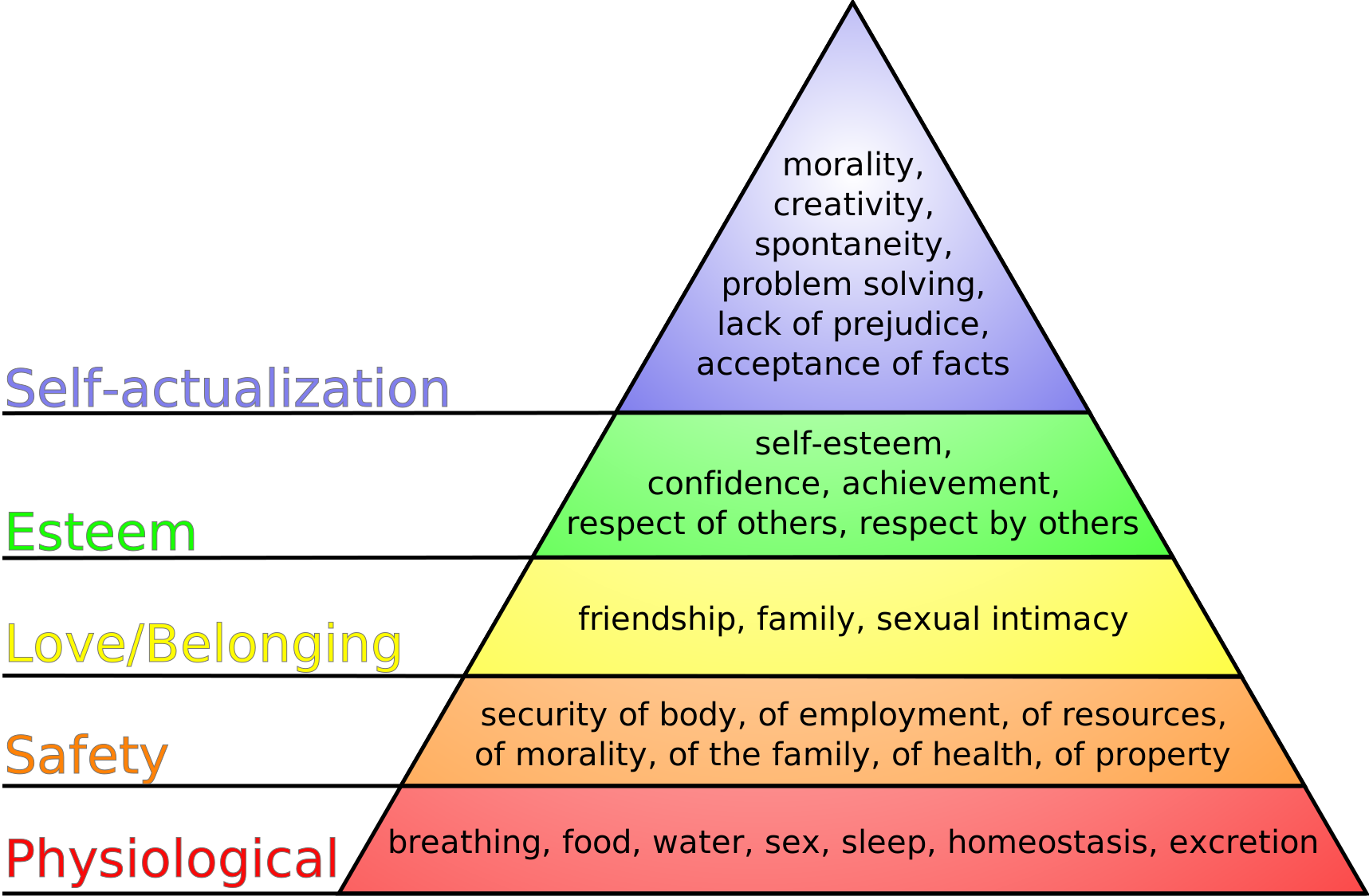
Many of us are familiar with Maslow's hierarchy of needs. We know that many things precede achievement, problem solving and creativity. Yet, with schools having such a big focus on the latter, it seems curious that we spend so little time on helping students build and develop their well being. You might argue that this is covered in the Health and Physical Education curriculum, but I would really question whether this is sufficient considering the home environments that some our students come from. 

I also wonder, what type of students our schools and the systems therein will be turning out? If we only teach and emphasise achievement, NCEA and national standards, then what are we teaching kids to value? I would argue that the same is true for teachers and other professionals, to what extent are we sending the message that results and achievement are more valuable than well being, happiness and quality relationships?
Image Source

This year, I have really enjoyed that working at Hobsonville Point means we are working at developing all of the students, not just their minds in class or the muscles in their sports teams. A large component of my role here is acting as a hub coach (for more information about hub coaches see Claire Amos's post). As this role evolved throughout the year, I found increasingly that it has dealt with friendships and family, with values, morals and respect. As most schools and teachers do, we have also dealt with safety of some of our students. But what really stands out for me about this year was the focus on student well being. The focus of developing student self-esteem and confidence and explicitly learning about respect and managing relationships. By working together in our hubs, we have given students a safe place within the school where they are able to explore some of the more personal things that we all go through as we learn to make sense of an adult world. Together our students have unpacked and reflected regularly using the hauora tools from the health curriculum. Together we identified strategies and unpacked scenarios where our well being might be out of sync, and what we might do about it. We talked about how we might support someone else who might be struggling spiritually, emotionally, physically or socially. 


In our hubs, we also unpacked the Hobsonville Habits. A set of ten dispositions that we aim to help our students develop. By calling them habits, we send the message that they are things we can develop until they become second nature. As a result, I am able to talk to the students in my hub, but also any student in the school, about how they might show more compassion. This might be in the context of looking after the school, our buildings, or their peers. 

Here are some of the activities that I did with my hub over the year in effort to build dispositional excellence:
The Love Wall
  • Unpacking the Hobsonville Habit of Purposeful, we read some exerts from Sean Covey's 7 Habits of Highly Effective Teens (Sean Covey is the son of Stephen Covey, author of 7 Habits of Highly Effective People). The students really loved the book. In particular we focussed on the chapter about being proactive. Over a series of lessons, we then unpacked acting in a proactive and reactive way in more depth. This involved listing some of the proactive and reactive ways that we act in different scenarios. I prompted students by giving them different scenarios and by looking at some movie clips. Mean Girls is great for this one. We also looked at the compass of shame, a great tool that allowed us to explore different types of reactive behaviour in more depth. Finally, we also did some role plays, where we acted out a challenging scenario where the student had to respond using only proactive responses. The rest of the group then gave the student feedback about their responses. And finally, no series of lessons at Hobsonville Point would be complete without some alone time to reflect.
  • Some of the simpler activities included the love wall, where every week for a term, students were asked to write something that they liked about themselves, but also something the liked about another student in the hub. These are displayed on the wall of our hub.
  • Steve Mouldey also introduced the students to Caine's Arcade. A powerful video of a young boy who created an arcade from cardboard boxes. Students then unpacked lessons from the Caine's arcade video.
  • Of course, no dispositional curriculum would be complete without a good selection of TED talks. Our favourite this year was probably the thirteen year old Logan LaPlante's TEDx talk, Hackschooling makes me happy. 

Other things that we explore in our hub is Hermann's brain, a tool which has allowed us to explore thinking preferences. This allowed us to help students explore how we learn, think and act in more depth. 

Most mornings in hubs also involved a quick check in with students. This might involve each person sharing what they most need to focus on for the week, how they are going, how they are feeling about particular events, etc. This often acts as a measure of where students are at, what support they need, whether they might need additional support in terms of strategies to cope or manage a situation, stress management or even referrals to the school councillor. 

Finally, there is also the ever important parent communication. By checking in with students, following their academic and dispositional progression and getting to know them very well through all the team building and discussion, we are able to bring parents and family on board to a much greater extent. Our conversations are often more meaningful and we are able to work together towards supporting our students.

All of the above, is only the first year of learning hubs. So as I sit and reflect about the where to next, I am as excited today as I was a year ago about the potential of the learning hubs at Hobsonville Point. Knowing that I have time and tools allocated to helping my students build their emotional and academic resilience, and their well being, that I can coach them through when they get stuck, and that that I am not alone in this, makes me excited for our students. It also gives me hope for the many under achieving students in our country. In fact, a 2014 Ministry of Education report about low decile schools that are performing well, actually talks about the success of schools who have adopted a similar model. 

Who would have thought that working with students around their whole well being, not just their academic achievement would have such great effects? Perhaps we all know. Or perhaps the real question is who is willing to rattle enough cages to make sure that every child has someone looking out for their well being? 

Quotes from my students: "Throughout the past year, my being has definitely grown and developed into something much better than what I started out like. One of my best highlights about my being is being able to learn more about my Hauora and getting to know more about how each of our quadrants in our Hauora needs to be equal and cared for." "Hub activities were new and different to me, it was interesting to get to know and understand different peoples opinions, to think about what others say and then take into account, how different we are but how we can still interact with each other." "My highlight for my being was that I have a better meaning and understanding of the word “respect” even though I have not fully changed, I am on a road to being a more respectful person to myself and others. I enjoyed learning about the difference between being reactive and proactive with my hub. This was useful because I now can have a look at different situations and understand how I can make the best of every situation." "I have learnt how to manage my emotions.  I have learnt different strategies to deal with conflict."